Welcome to the land of fire and ice! Catania is a truly magical place full of great people, awesome food and lots of stuff to see and do. You need to get this one on your bucket list.



The Fish Market
Let’s start with the fish market.
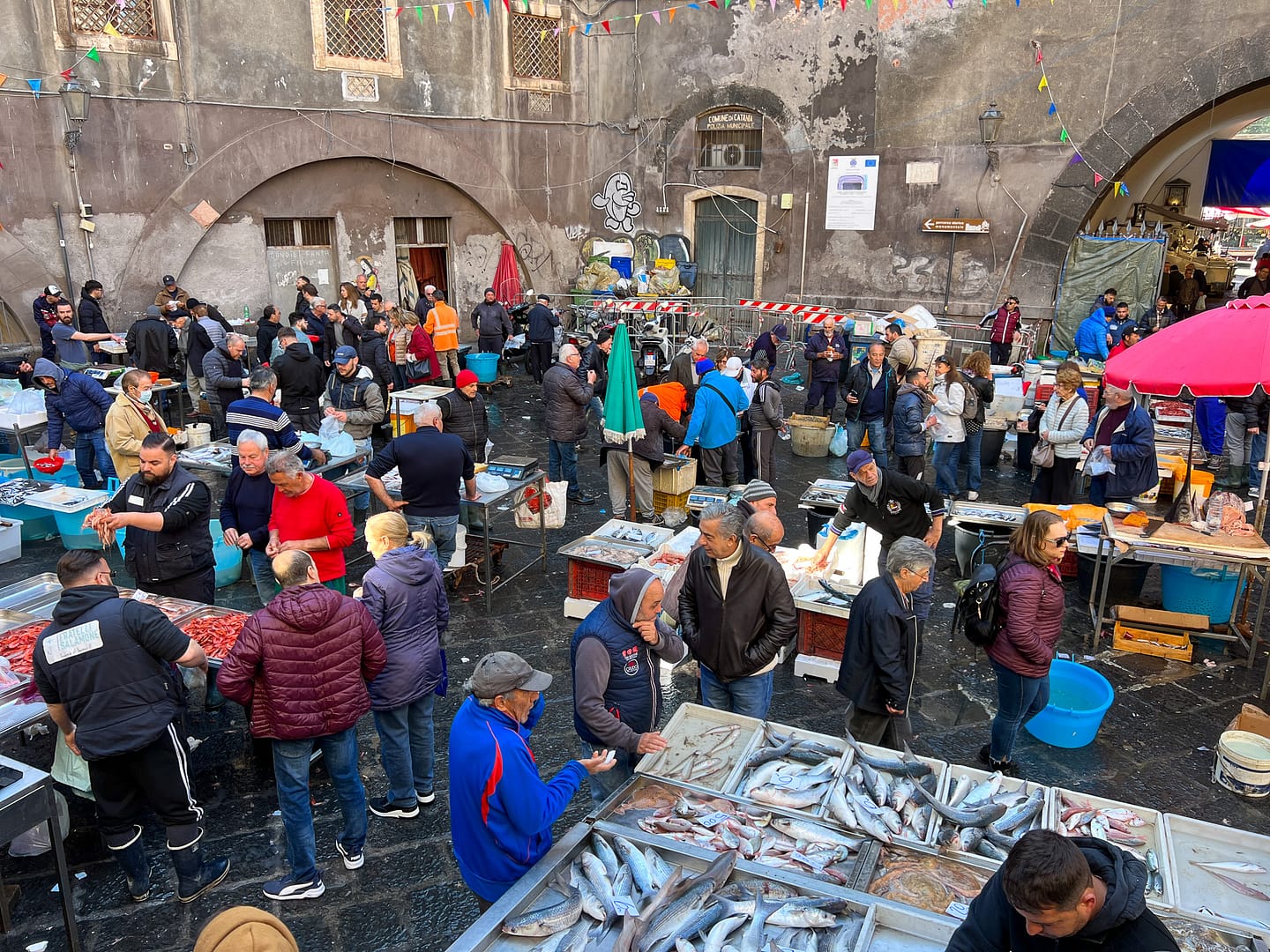
Catania’s Fish Market (La Pescheria) is famous worldwide and has been operating since the 1700s. The market is a maze of narrow streets and alleys lined with colorful stalls selling a dizzying array of fresh fish and seafood. From swordfish and tuna to octopus and squid, the market is a seafood lover’s paradise.
As we wandered through the market we couldn’t help but be struck by the lively atmosphere and the hustle and bustle of the vendors and shoppers. The vendors are “passionate” (a.k.a. energetically, enthusiastically loud) about their trade as they compete with one another for your business. It’s a true, not to be missed, spectacle.

We spent two full mornings roaming around and taking everything in. If you allow yourself to just hang out and watch what’s going on it is true theater and as entertaining as anything you’ll see or do in Catania.
You can check out our video on the market here. You’ll definitely be motivated to go. And make sure you watch til the end! We have no idea who the little man is (he is obviously well-known) but it’s the guy who sneaks in behind everyone you don’t want to miss. Gross!
The San Berillo District
The origins of San Berillo date back to the 17th century when it was founded as a residential district for the city’s wealthiest citizens. Over time, however, the area began to attract a more “diverse” population. As a result, by the 20th century, San Berillo became well-known for its vibrant nightlife and bustling red-light district.

Today, San Berillo is in the midst of a cultural and artistic revival. Many of the district’s historic buildings and alleys have been renovated and repurposed, creating a vibrant hub of creative activity in the heart of Catania. The neighborhood is now home to a thriving community of artists, musicians and creatives and it’s a popular destination for visitors looking to explore Catania’s alternative culture scene.
Despite its transformation, San Berillo still faces challenges. Poverty and social issues persist in the area and the district is still recovering from the impact of years of neglect and disinvestment. But don’t let that deter you from having a good look around. It’s a charming one of a kind place.

History
The city of Catania was founded by the Greeks in the 8th century BC and it quickly grew into a thriving city-state known for its agriculture, trade and culture.
In the centuries that followed Catania was ruled by a succession of different powers including: the Romans, Byzantines, Arabs, Normans, and Spanish. Each of these civilizations left their own unique mark on the city’s architecture and culture and you’ll see that as you make you’re way around the city.
One of the most significant events in Catania’s history was the eruption of Mount Etna in 1693. The eruption destroyed much of the city’s most important buildings and landmarks. The city, however, was quickly rebuilt and many of its most iconic buildings, such as the Baroque Cathedral of Saint Agatha, were constructed in the aftermath of the eruption.
In more recent times, Catania has been shaped by its role as a major port and industrial center. Still, despite the challenges of industrialization and urbanization, Catania has managed to preserve much of its unique character and charm. We absolutely loved our time there.
Architecture
Catania is a city with a rich history and culture and its architecture is a testament to its many influences and periods of prosperity.
One of the most distinctive features of Catania’s architecture is its use of dark volcanic stone, a material that is readily available in the region due to the presence of Mount Etna. Many of the city’s buildings are made from this dark stone, giving them a unique and striking appearance that sets them apart from other Italian cities.
And the city’s architecture has been shaped by a variety of influences over the centuries. In the ancient period Catania was a Greek colony and many of the city’s oldest ruins are of Greek origin; including the amphitheater and the Odeon. The Romans also left their mark on the city, with impressive structures such as the baths, the aqueduct and the theater.
During the Middle Ages Catania was an important center of trade and commerce and its architecture reflects this period of prosperity. The city’s numerous churches and palaces are prime examples of the Gothic and Renaissance styles that were popular in Europe at the time.
However, it was the Baroque period that had the most significant impact on Catania’s architecture. The 1693 earthquake was devastating and much of the city’s buildings were destroyed. The Baroque style, with its grandeur and theatricality, was in vogue and the result is a stunning array of Baroque palaces, churches and monuments that dominate the cityscape.
The Buzz
Here is a video we did of our travels in Catania. You’ll see it all in here.
Catania is a great walking city. So just throw away the map, put your phone in your pocket and go and get lost. There are wonderful surprises around nearly every corner.
Bars and coffee shops are everywhere and we really enjoyed ourselves at Vermut. You won’t be dazzled by the food or the drinks but everything, including the service, is generous and inexpensive. It’s away from all of the commotion of the center and when you throw in the great student vibe? It’s a big winner. We had a lot of fun there.
One place that does have great food and wine though is a seafood restaurant that was just around the corner from our AirBnb: Ristorante da Antonio. Everything was delicious and the terrace was beautiful. We’d go back in a heartbeat.

Another place definitely worth a stop is the glass art studio Vetriamo. You’ll find some real treasures here and the prices are dangerously good! We bought a lot of gifts here for friends and family.
All in all? You won’t disappointed by Catania. It’s a great city. A little raw and gritty like Palermo? Yes. But loaded with character, vitality and enthusiasm. Don’t miss it if you have a chance to visit Sicily.
Leave a Reply